Countdown on Your Credentials: The Truth About How Long Colleges Keep Your Academic Records
There is a quiet assumption shared by millions of American college graduates: that somewhere in a server room or records vault, their transcripts are waiting patiently, preserved indefinitely, ready to be summoned at any moment. That assumption is understandable — and frequently wrong.
The reality governing academic record retention in the United States is neither uniform nor particularly reassuring. What exists instead is a layered, often contradictory framework of federal suggestions, state-specific statutes, and institutional policies that vary not just from state to state, but from one college to the next — and sometimes from one department to another within the same institution.
For alumni who may need certified copies of their academic records years or even decades after graduation, this patchwork system carries real consequences.
No Federal Mandate, No Universal Standard
The first thing to understand is that no single federal law compels colleges and universities to retain student academic records for a specific number of years. The Family Educational Rights and Privacy Act (FERPA), which governs student privacy and access rights, does not establish retention schedules. It protects the records that exist — it does not require institutions to maintain them indefinitely.
The federal government does impose record-keeping requirements tied to specific programs. Institutions participating in Title IV federal financial aid, for instance, are generally required to retain certain financial and enrollment records for a defined period — often three to five years following the end of the award year. But those requirements address financial documentation, not necessarily the academic transcript itself.
In the absence of a federal floor, the burden of establishing retention timelines falls to states and, ultimately, to individual institutions.
The State-by-State Divide
Across the country, state-level requirements for academic record retention vary considerably. Some states mandate that public colleges and universities preserve permanent academic records — typically defined as the official transcript — indefinitely. California, for example, maintains relatively robust requirements for public institutions within the University of California and California State University systems. New York's public university system similarly imposes strong retention obligations.
Other states are far less prescriptive. In those environments, community colleges or smaller private institutions may retain comprehensive academic records for as few as five to ten years before transitioning them to long-term archival storage — a migration that can dramatically complicate retrieval.
Private colleges and universities operate under even greater variability. Without a state mandate compelling permanent retention, some institutions establish their own internal policies that may fall short of what alumni reasonably expect. A small private college that closes or merges with another institution presents particular challenges, as explored in prior coverage of what happens when colleges disappear entirely.
What "Retention" Actually Means in Practice
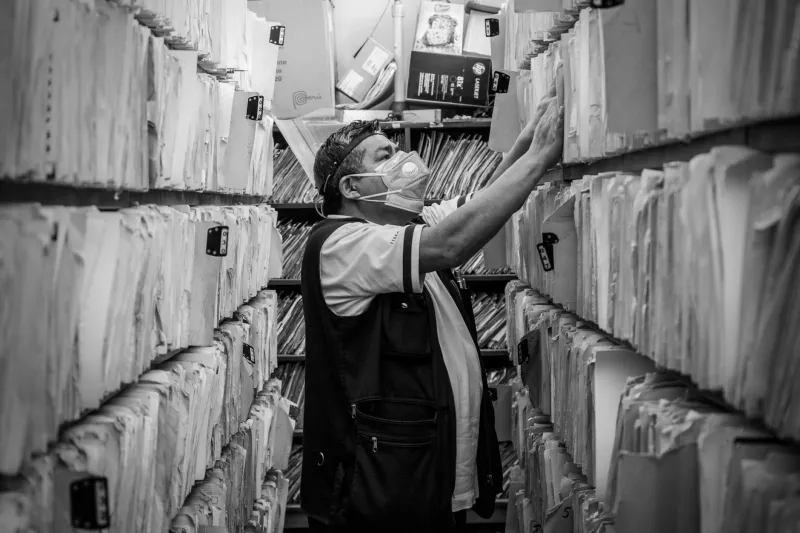
The word "retention" can obscure as much as it reveals. When a college says it retains records for fifty years, that does not necessarily mean those records are easily accessible. There is a meaningful difference between records that are digitally indexed and retrievable through an online portal and records that have been transferred to microfiche, moved to off-site storage, or handed over to a state archive.
Microfiche storage, in particular, has become a quiet crisis in academic records management. Institutions that converted paper records to microfiche in the 1970s, 1980s, and 1990s may technically "have" those records — but retrieving them requires specialized equipment, trained staff, and sometimes weeks of processing time. For alumni who need a certified transcript quickly for a job offer, a professional licensure application, or a graduate school deadline, that distinction is not trivial.
Digital record systems have improved the situation considerably for recent graduates, but they have not eliminated the problem for those who graduated before widespread digitization. Many registrar offices still maintain hybrid systems where older cohorts of alumni exist only in analog formats.
The Seven-Year Myth — and Where It Comes From
The "seven-year" figure that sometimes circulates in conversations about academic records likely originates from confusion with other record-keeping contexts — most notably the Fair Credit Reporting Act, which governs how long negative information can remain on a consumer credit report. Applied to academic records, the seven-year timeframe has no specific federal basis.
That said, some institutions do use a seven-year window as a benchmark for certain ancillary records — advising notes, non-grade correspondence, disciplinary files that did not result in permanent notations, or departmental records that fall outside the official transcript. The official transcript itself is generally treated differently, with most accredited institutions recognizing an obligation to preserve it for a substantially longer period, if not permanently.
Alumni should not conflate the treatment of supplementary records with the treatment of their core academic documentation.
When Records Are Transferred, Archived, or Lost
Institutional closures and mergers represent the highest-risk scenarios for academic record loss. When a college ceases operations, responsibility for its records typically transfers to a state agency, a successor institution, or an accrediting body. The transfer process, however, is not always seamless, and alumni sometimes discover that their records are technically held by an entity that lacks the infrastructure to respond to transcript requests efficiently — or at all.
Even without closure, records can become effectively inaccessible through institutional neglect, underfunded registrar operations, or the simple passage of time. Alumni who graduated thirty or forty years ago from institutions that have since undergone multiple system migrations may find that their records exist in a format no current staff member knows how to retrieve.
Practical Steps Every Alumnus Should Take
The most important action any college graduate can take is proactive, not reactive. Waiting until a specific need arises — a job change, a licensure renewal, a graduate application — to request certified copies of academic records introduces unnecessary risk.
Consider the following steps:
Request certified copies now. Most registrar offices can issue official transcripts on demand. Alumni who graduated more than fifteen years ago, attended institutions that have since closed or merged, or hold degrees from smaller private colleges should prioritize this. Multiple certified copies stored securely at home provide a buffer against future retrieval complications.
Verify your institution's specific retention policy. Contact the registrar's office directly and ask, in writing, what the institution's current policy is for retaining academic transcripts and degree records. Document the response.
Check for state archive programs. Several states maintain centralized repositories for academic records from closed institutions. The National Student Clearinghouse also maintains enrollment and degree data for a substantial portion of US institutions, though its records are not a substitute for a full official transcript.
Monitor institutional changes. Mergers, acquisitions, and closures in higher education have accelerated in recent years. Alumni of smaller or financially stressed institutions should stay informed about their alma mater's operational status.
The Verification Imperative
At ResultBSEB, the underlying mission is straightforward: academic results should be instantly and reliably verifiable, regardless of when or where a credential was earned. That mission runs directly into the structural vulnerabilities described above. A credential that cannot be verified — because the records have been purged, archived beyond practical access, or lost in an institutional transition — is a credential that cannot fully serve the person who earned it.
The burden of protecting academic records should not fall entirely on individual alumni. But until federal standards or state mandates catch up to that ideal, the most reliable protection remains a proactive one: request your records, preserve them securely, and do not assume they will always be waiting when you need them.